Training
Duration: 1 day
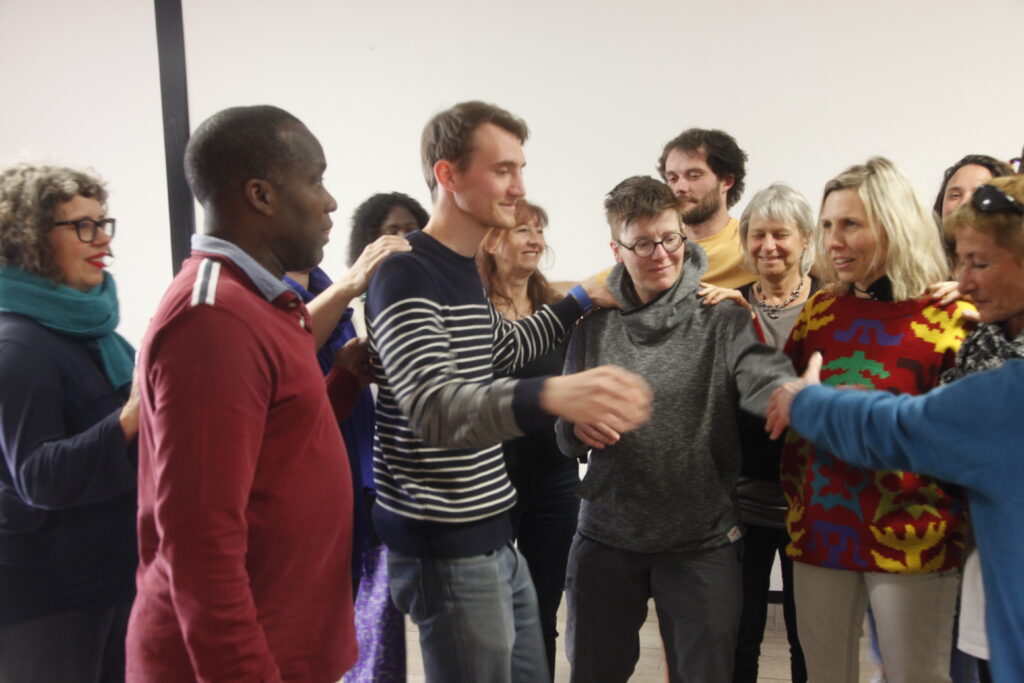
It is about reflecting on our everyday practices – within our families, at work, in our neighbourhoods and in the public sphere. It is about reflecting on what comes easily to us and what does not, receiving feedback, exploring issues in greater depth, consolidating what we have learnt, making things run more smoothly, and taking things further.
It is also an opportunity to meet up again and explore different forms of mutual support during the workshops, within the network of alumni from the ‘Non-violence and Transitions’ course, and across our various communities…
For whom?
For those who have completed workshops as part of the CNV programme on internal, social and ecological transitions.
End-of-programme practice analysis
For those who have completed 3 or 4 workshops in the programme.
Practice analysis at the start and midway through the programme
For those who have completed at least 1 or 2 workshops in the programme. This means that those nearing the end of the programme are also welcome to attend!
Practice analysis for trainers and facilitators
For NVC trainers – whether certified or currently training – or anyone facilitating groups who has completed at least one systemic NVC workshop with me.
Content:
The programme will be developed jointly with the participants in advance and each morning, based on their requests and needs.
Morning:
Check-in, feedback, practical exercises, Q&A, introduction to additional concepts and tools, realignment.
Afternoon:
Physical movement, rotating sessions: 30-minute one-to-one coaching sessions alongside practical exercise sessions, Q&A, mutual support, wrap-up.
—
Examples of topics covered (in practice or in theory) depending on requests
For all workshops
Joy, renewal and forms of mutual support in commitment
Knowing how to share one’s experiences (drawing on experience, expression and sharing: friends, family, work, the public sphere)
How to effectively facilitate the EDA mutual support exercise! (Listening, Discernment, Action!)
…
End-of-course practice analysis
Moving from Karpman’s drama triangle (rescuer, victim, persecutor) to the virtuous circle (facilitator, creator, challenger) on a social or environmental issue
4 ontologies of nature… and robotic animism and generative artificial intelligence in the West
Gender and sexuality: how the personal is political
Overcoming shame regarding social or environmental issues
Overcoming fear regarding social or environmental issues
Daring to take a radical, non-violent stance (with the systemic giraffe cry)
Being an ally or realigning: daring to lead in social and environmental change
…
Practice analysis at the start and midway through the programme
Can I perceive the tangible effects of the social on my body and my reactions? (Bourdieu’s ‘capital’ and ‘bodily hexis’)
Receiving feedback (when I have had an impact): practising
Authentic expression or giving feedback when I have been affected: practising
Acting as a witness: practising
Reviewing the ‘stop’ signal, daring to give feedback
Interdependence in everyday life – what does this mean?
Restoring fairness before engaging in dialogue – how do we do this in our daily lives?
…
Practice analysis for trainers
Mixed/heterogeneous groups: recognising one’s own and the group’s limits
Speaking simply and calmly about systemic theory
Welcoming participants’ emotions within the framework of systemic awareness
Actively contributing to awareness-raising without being overbearing
Teaching team: composition, preparation, debriefings
Sharing ‘failed’ or ‘successful’ experiences and debriefing
Allowing beauty to emerge (safe space, empowerment, letting go)
Teaching approach:
Through experience and awareness arising from the needs of the participants: individual or group verbal and non-verbal body practices, role-playing and enacting situations, debriefing, input.
Duration: 1 day
Rates:
- You fund your own participation:
The workshop relies on a conscious financial contribution (CFC)
What is CFC?
Accommodation and meals not included.
To confirm your registration, you will be asked to pay a deposit of €15. Should you need to cancel, the deposit is non-refundable but can be transferred to another course. If you are experiencing financial difficulties, including with regard to this deposit, please contact us.
Diversity and equity:
Economic resources, level of education, gender, ethnicity, disability or illness, religion, age… if you are personally concerned by any of these or other topics, you can share with me what would be helpful for you to attend, either in the registration form or by sending me a text message specifying the topic at (+33) 7 77 93 82 98: I will call you back.
Location:
Marseille 13004
Upcoming dates
Testimonials
Would you like to develop a Non-Violent Communication
or a Forum Theatre-NVC workshop in your institution or company?